
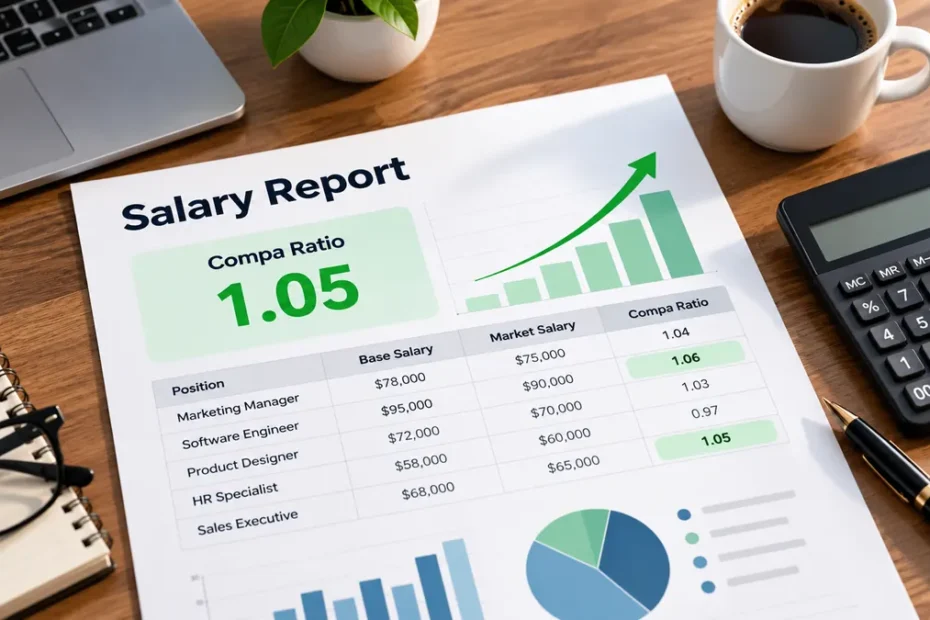
You spotted “compa ratio” on a compensation report and froze. Most employees never question this number, leaving thousands of dollars on the table each year. Understanding compa meaning gives you the exact tool to measure whether your pay matches the market rate. This guide explains the concept in plain language so you can negotiate smarter.
What Is the Compa Meaning in Simple Terms?
The compa meaning refers to “comparative ratio.” It compares your actual base salary to the midpoint of your designated pay grade. HR professionals use this metric to evaluate internal pay fairness across an entire organization (WorldatWork, 2023). The term gained traction in compensation management during the 1980s as companies needed standardized pay measurement.
How Do You Calculate a Compa Ratio?
Divide your annual salary by the midpoint of your salary range. An employee earning $60,000 with a range midpoint of $55,000 has a compa ratio of 1.09. Multiply the result by 100 if your organization expresses ratios as percentages. This straightforward formula reveals exactly where you stand.
What Does a 1.0 Compa Ratio Signify?
A ratio of 1.0 means your pay sits exactly at the market midpoint. You earn precisely what the organization considers competitive for your role and experience level. New hires typically start below 1.0 and grow toward it as they gain skills and tenure.
Is a High Compa Ratio Always Good?
Not necessarily. A ratio above 1.2 may signal that your pay exceeds the market rate, which could limit future raises. Employers may freeze your salary until the market catches up. The compa meaning shifts depending on your career stage and industry benchmarks.
Compa Meaning vs. Salary Range: Key Differences
A salary range shows the minimum-to-maximum pay band. The compa meaning zeroes in on your position relative to the midpoint alone. Think of the range as the entire highway and the compa ratio as your exact mile marker. Two employees in the same range can hold vastly different ratios based on performance.
Who Uses Compa Ratios and Why?
HR teams, compensation analysts, and hiring managers rely on compa ratios daily. They use these numbers to maintain pay equity, set department budgets, and flag underpaid employees before turnover spikes (SHRM, 2024). Board members also review aggregate compa data during executive pay audits.
Compa Ratio Benchmarks by Industry
Tech companies often target 0.95–1.10. Healthcare organizations lean toward 0.90–1.05. Government roles typically hover near 1.0. Startups may run lower ratios around 0.85 due to equity compensation offsets. Knowing your industry standard helps you interpret compa meaning accurately.
How Does Compa Meaning Affect Pay Equity?
When groups of employees show consistently low ratios, it signals systemic pay gaps. Organizations committed to fairness audit compa ratios by gender, race, and tenure to close disparities (U.S. Bureau of Labor Statistics, 2024). Several states now require pay transparency reports that include compa ratio breakdowns.
Common Compa Ratio Mistakes to Avoid
- Ignoring midpoint shifts after annual market adjustments
- Comparing your ratio to a colleague in a different pay grade
- Assuming a 1.0 ratio automatically guarantees a raise
- Overlooking geographic pay differentials that adjust the midpoint
How to Use Compa Meaning in Salary Negotiations
Request your pay grade midpoint from HR. If your compa ratio sits below 0.90, you have strong data to justify a raise. Pair your compa meaning data with documented achievements, client feedback, or revenue contributions to build an undeniable case.
Compa Ratio Table: Quick Reference Guide
| Compa Ratio | Pay Position | What It Tells You |
| Below 0.80 | Significantly underpaid | Immediate compensation review needed |
| 0.80 – 0.90 | Below market rate | Raise conversation strongly warranted |
| 0.90 – 1.00 | Approaching midpoint | Competitive but room to grow |
| 1.00 | At market midpoint | Fairly compensated for your role |
| 1.00 – 1.10 | Above midpoint | Strong pay position maintained |
| Above 1.20 | Top of range | Limited future raise potential |
Conclusion
Stop guessing whether your paycheck reflects your true value. Pull your latest compa ratio, compare it against the benchmarks above, and schedule a compensation review with your manager this quarter. Your future earnings depend on the action you take right now — not next year.
Featured Guides
Hand‑picked stories you don’t want to miss

NGL Meaning in Text: What It Stands For & When to Use It
Decode “not gonna lie” — the texting acronym that softens honesty and builds trust in casual chats.
Read Guide
Zero Proof Meaning Explained: What Does It Actually Mean?
From cocktail menus to grocery shelves — understand the 0.0% ABV promise and why it’s trending.
Read Guide
SS Meaning in Chat: Complete Guide for Texting & Gaming
Screenshot or missing enemy? Learn every meaning of SS across WhatsApp, Snapchat, and competitive games.
Read Guide