
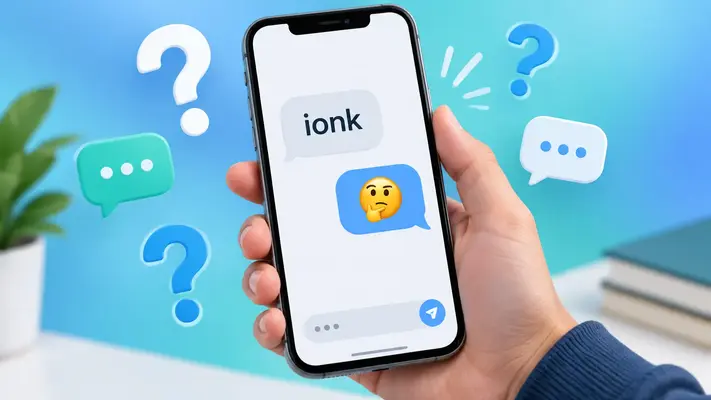
You do not know what “ionk” means, but someone just texted it to you. You Googled it and got five different answers.
That’s not your fault. This word has no official definition, and many sites simply guess. Here are the three readings that actually hold up, plus a fast way to tell which one your friend meant.
What Does IONK Mean in a Text Message?
The honest answer is that IONK has no single, agreed meaning. It isn’t in any major slang dictionary I could find, and it hasn’t gone viral the way “rizz” or “bet” did.
That leaves three realistic explanations. Each depends on who sent it, how they write, and what the chat was about.
Think of it like a private nickname. It can carry real meaning between two people and still mean nothing to the rest of the internet.
Meaning 1: “I Don’t Know” (Most Likely)
This is the strongest candidate. “ION” is texting slang for “I don’t” or “I do not,” and it comes from African-American Vernacular English.
Add the “k” and you get a phonetic spelling of “ion know,” which sounds like “I don’t know.” Some people also type it as a quick, lazy version of IDK.
Here’s how it looks in a real chat:
- Friend: “Are you coming Friday?”
- You: “ionk, depends on work”
If the reply sounds unsure or shrugs something off, this is almost certainly your answer.
Meaning 2: A Honking Sound
Some pages describe IONK as an onomatopoeia, a word that imitates a noise. They say it stands for a loud honking sound, like an impatient driver or an annoying goose.
I’d treat that claim with caution. It comes from a thin, low-quality page with no real source behind it. Still, “honk” is a genuine sound word, and people do play with spellings like “ionk” for comic effect.
This reading fits when the message is silly or describes a noisy scene. Imagine “traffic was insane today, ionk ionk.”
Meaning 3: A Typo or Personal Shorthand
Sometimes it’s just a slip. The “I” and “O” keys sit close together, and “ionk” can come from mistyping “honk,” “ink,” or “ion” followed by a stray “k.”
It can also be a private joke. Friend groups invent words all the time, and the meaning may exist only in your chat.
How to Decode IONK in 30 Seconds
You don’t need to guess. Before responding, use this simple check.
- Look at the question. If it asked for an opinion or a plan, think “I don’t know.”
- Check the mood. Jokes and exaggeration point toward the honking sound.
- Scan their history. If they often type in short, phonetic spellings, it’s slang.
- Notice the punctuation. Repeated “ionk ionk” usually means a sound effect.
- Ask. A brief “pause, what does ionk mean?” works, and nobody will judge you.
Quick Comparison: IONK vs Similar Slang
| Term | Likely Meaning | Tone | Established Slang? |
| IONK | “I don’t know” or a honk sound | Casual, playful | No |
| IDK | I don’t know | Neutral | Yes |
| ION | I don’t | Casual | Yes |
| ION (alt.) | In other news | Casual | Yes |
| IDC | I don’t care | Blunt | Yes |
The pattern is clear. IONK sits closest to ION and IDK, but it hasn’t earned a standard spot in texting vocabulary.
Why ION Matters for Understanding IONK
To decode IONK, you need to understand ION, its closest relative. ION is a real, widely used slang term, and it has several meanings.
Besides “I don’t,” it can also mean “In Other News,” “It’s On Now,” or “I Only Need,” depending on context.
“I Don’t” in Everyday Use
This is the most common one. When someone says “ion enjoy pizza” or “ion want to go,” what they really mean is “I don’t.”
If your contact writes “ion” this way, then “ionk” as “I don’t know” is a natural next step.
“In Other News” as a Topic Switch
People also use ION to change the subject smoothly. It works like a verbal shrug: “ION, did you see the game?”
It’s worth remembering, because if “ionk” shows up mid-conversation before a new topic, this might be a related use.
Common Mistakes When Reading Unknown Slang
Slang moves fast, and it’s easy to trip up. I see these mistakes the most frequently.
- Trusting the first search result. Many SEO pages repeat each other without checking anything.
- Confusing it with science. In chemistry, an “ion” is a charged atom, which has nothing to do with texting.
- Ignoring the sender. Age, region, and friend group all change how a word gets used.
- Overthinking it. Most short slang is just casual shorthand, not a hidden code.
Some sites also stretch “ion” into vague claims about emotional “charge” or “tension” in messages. That’s filler with no basis in real usage.
How to Respond If You are Still Uncertain
You have three easy options, and none of them make you look out of touch.
Option 1: Ask directly. Type “lol what does ionk mean?” It’s honest, quick, and friendly.
Option 2: Mirror the tone. If the message sounds like a shrug, reply with something open-ended like “no worries, let me know.”
Option 3: Wait for context. Follow-up messages often clear things up on their own.
Asking is almost always the safest choice. People enjoy explaining their own slang.
Should You Use IONK Yourself?
Probably not, unless you’re texting someone who already uses it. The majority of readers will not comprehend you because there is not a conventional meaning.
Stick with IDK or “I don’t know.” Both are universally clear and keep your message from being misread.
Frequently Asked Questions
What does IONK mean in text?
There’s no official definition. It most likely means “I don’t know,” built from the slang “ion” (I don’t) plus “know.” In a joking chat it may also imitate a honking sound.
Is IONK the same as IDK?
They often carry the same meaning in practice, but they aren’t equal. IDK is established texting slang, while IONK is a rare, informal variant that only some people use.
What does ION mean in text?
Most often it means “I don’t,” as in “ion like that.” It can also mean “In Other News” when someone switches topics.
Is IONK a real slang word?
Not in the way “lol” or “bet” are. I couldn’t find it in major slang references, so treat it as informal, personal, or regional shorthand.
Could IONK be a typo?
Yes. The letters sit close together on a keyboard, so it may be a mistyped “honk,” “ink,” or “ion.” If the message reads oddly, ask the sender.
Does IONK mean the sound of a horn?
Some websites say so, but the evidence is thin. It’s plausible in a joking context, so let the tone of the chat guide you.
How do I find out what a slang word means?
Check the sender’s other messages, search a trusted slang dictionary, or simply ask. Asking beats guessing.
Conclusion
Treat IONK as a casual “I don’t know” unless the chat says otherwise. Nothing suggests it’s an official term, so context and the sender matter more than any dictionary.
Here’s my insider tip. When a word has no solid definition anywhere, stop searching and send one short question to the person who wrote it. You’ll get the real answer in seconds.